

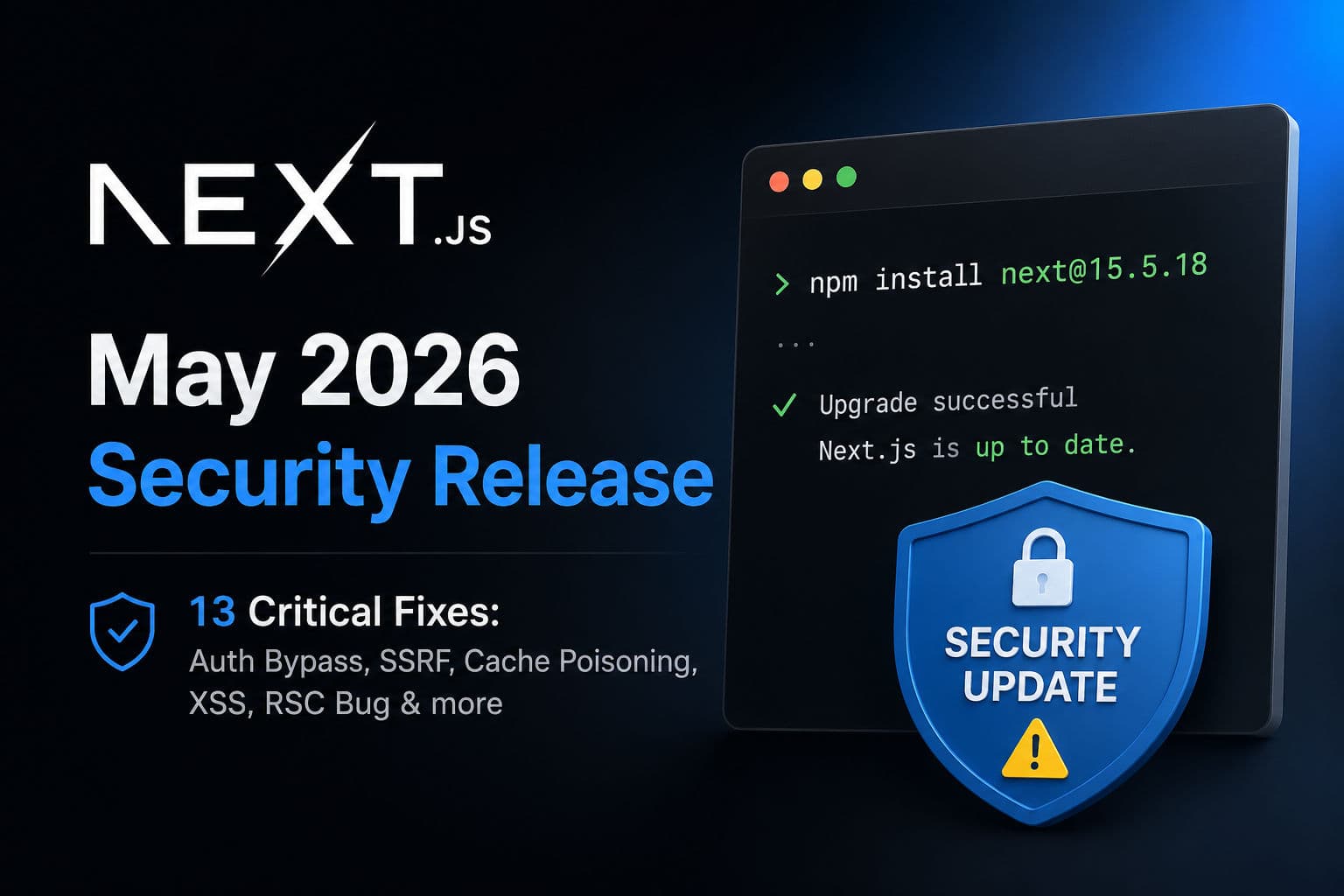
Next.js dropped a significant security release in May 2026 — 13 fixes across auth bypass, denial of service, SSRF, cache poisoning, XSS, and an upstream React Server Components vulnerability. If you’re running any affected version in production, there’s no mitigation path: you patch, or you’re exposed.
Here’s what the release actually covers, and how I think about security hygiene on Next.js projects.
1. What was patched
The May 2026 release covers a wide surface area. The categories that stood out to me:
- Auth bypass — the worst class of bug in any framework. If middleware or route-level auth checks can be circumvented, your entire access-control model collapses.
- SSRF (Server-Side Request Forgery) — attackers coercing your server into making internal requests. In App Router apps that fetch from internal services or third-party APIs server-side, this is a real risk.
- Cache poisoning — particularly nasty in Next.js because the framework’s caching is aggressive by default. A poisoned cache entry can serve malicious content to thousands of users before you even notice.
- XSS — cross-site scripting. React mitigates a lot of this at render time, but framework-level XSS vectors exist outside React’s control.
- Denial of service — crafted requests that exhaust server resources. In serverless environments (Vercel, AWS Lambda), this can also spike your bill before you notice the attack.
Thirteen issues in a single release is a lot. It doesn’t mean Next.js is unusually insecure — it means the team did a thorough audit pass. But it does mean the delta between a patched and unpatched version is unusually large right now.
2. The RSC upstream bug
One of the fixes in this release covers an upstream bug in React Server Components — specifically in the react-server-dom-* packages. This is worth flagging separately because it’s not “just a Next.js bug.”
RSC is still a relatively young primitive. The serialization layer — how server components pass data to the client — is complex, and that complexity creates surface area. The fact that an upstream React bug made it into a Next.js security release tells me the framework and the renderer are more tightly coupled at the security level than most developers assume.
If you’re running react-server-dom-webpack or react-server-dom-turbopack directly (or via a custom bundler setup), check the release notes for which specific versions are affected — the Next.js patch bundles the fix, but custom setups might need a manual bump.
3. Which versions to update to
The patched versions are:
- Next.js 15.5.18 — the stable channel fix
- Next.js 16.2.6 — for projects on the v16 prerelease track
Run the update now. This isn’t a “schedule it for next sprint” situation. Auth bypass and SSRF vulnerabilities are actively targeted, and with a public release the attack surface is documented.
      # Update to the patched stable release
      npm install next@15.5.18

      # Or if you're on the v16 track
      npm install next@16.2.6

      # Verify the installed version
      npx next --version
After updating, run your test suite. The 13 fixes touch enough of the framework internals that you’ll want to catch any behavioral regressions before they reach production.
4. Server Actions & the new data security docs
Alongside the security release, the Next.js team extended their guides for data security and mutations — specifically covering Server Actions. This is timely.
Server Actions are one of the easier places to introduce security issues in an App Router app. A few patterns I see get developers into trouble:
- Trusting user-supplied IDs without ownership checks — e.g., passing a
postIdfrom the client directly to a DB delete without verifying the current user owns that record. - Returning full database objects from actions when only a subset is needed on the client — data leakage that’s invisible at runtime.
- Skipping input validation server-side because “the form already validates on the client.” Client validation is UX, not security.
The updated docs now address these patterns explicitly. Worth reading even if you think you’re already doing things right — the framing around “treat every Server Action as a public API endpoint” is a useful mental model.
5. What I actually check on client Next.js projects
Security patches like this one always prompt me to run through a short mental checklist on any active Next.js project. Here’s the honest version of what I look at:
- Middleware auth coverage. Is every protected route actually behind the middleware matcher? It’s easy for new routes to be added and inadvertently slip outside the matcher pattern. I’ve seen this on projects that started with a simple matcher like
/dashboard/:path*and then added an API route that nobody realized needed protection. - Server Action ownership checks. For any mutation action, does it re-verify the user’s session server-side before touching data? Not just “is the user logged in” — but “does this user own this resource?”
- Environment variable exposure. Are any secrets accidentally prefixed with
NEXT_PUBLIC_? It happens more than people admit, especially when a project changes hands or onboards a new developer quickly. - Cache headers on sensitive routes. Aggressive caching is great for performance. It’s catastrophic on routes that return user-specific data. Check that
/api/account,/api/orders, etc., are explicitly opting out of the framework’s cache. - Next.js version lag. After this release, any project still on 15.5.17 or below is in a known-vulnerable state. I track this the same way I track outdated WordPress plugins — version lag is a liability.
None of this is exotic. But the boring checklist is what actually keeps apps clean. The interesting architectural work — RSC patterns, streaming, edge deployment — all runs on top of a foundation that has to be secure first.
6. Staying ahead of Next.js security
The practical answer is simple: watch the Next.js releases page and subscribe to GitHub’s npm advisory feed for Next.js. Security advisories in the npm ecosystem now surface quickly, and the window between public disclosure and active exploitation keeps shrinking.
For teams: add a next version check to your CI pipeline. A simple check that fails the build if the installed version is behind the latest patch release takes about 10 minutes to set up and gives you automated visibility into version lag.
If you’re building a production Next.js app and want a second pair of eyes on the security posture — auth flows, Server Action safety, caching strategy — book a development consultation. It’s the kind of review that catches the boring-but-critical gaps before they become incidents. You can also browse the case studies to see how I approach App Router projects end to end.