

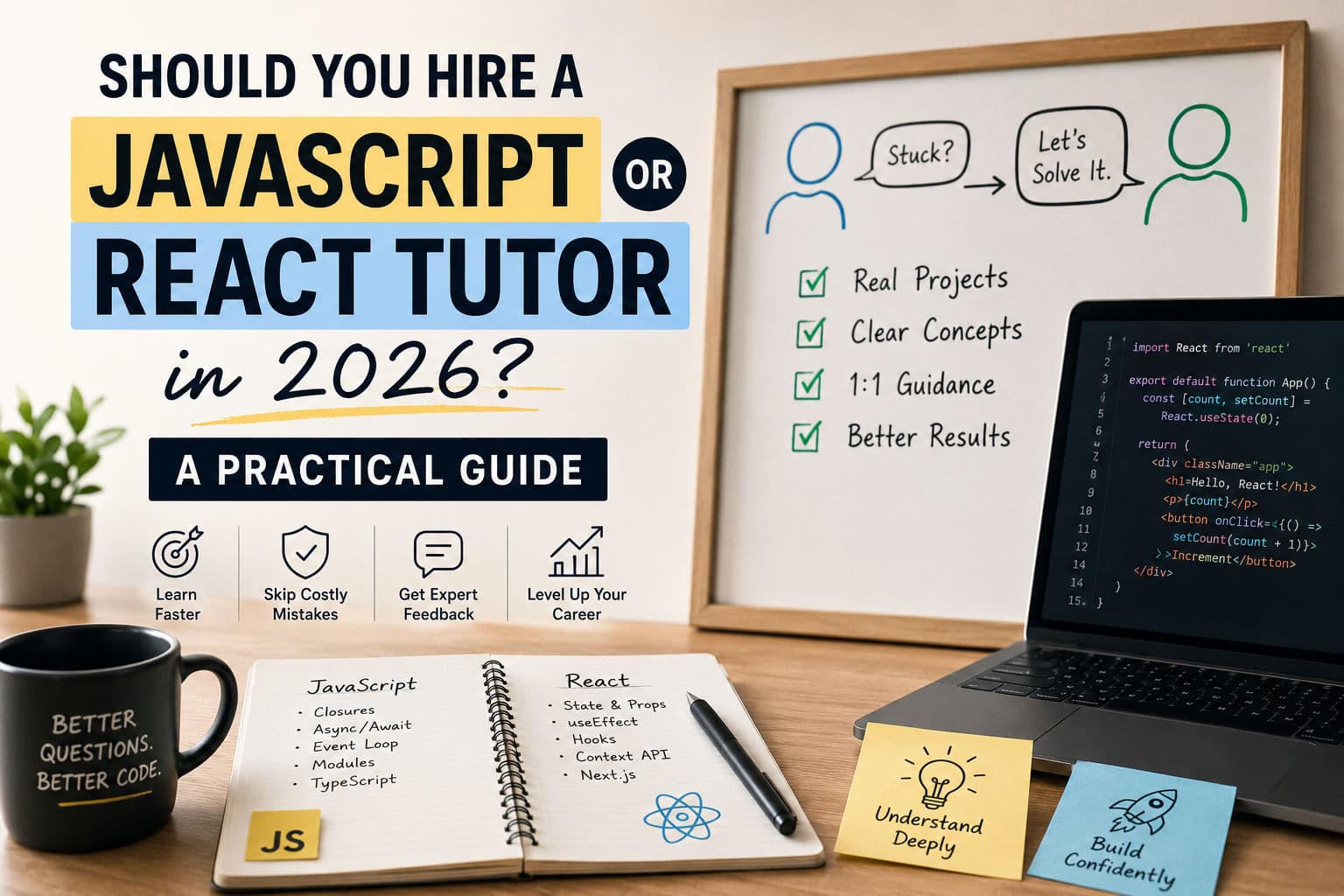
Hiring a JavaScript or React tutor in 2026 is a different decision than it was five years ago. AI assistants will autocomplete most of what a junior dev writes. Free courses cover the basics better than most paid bootcamps used to. Stack Overflow exists. So when does paying for 1:1 tutoring still make sense — and when is it just an expensive way to learn what a free YouTube playlist could’ve taught you?
This is the guide for working developers, career-switchers, and bootcamp grads trying to figure out whether 1:1 tutoring is worth the money in 2026. It covers when to book, when to skip, what to expect from a good JavaScript tutor or React tutor, what things cost, and the specific questions to ask before paying for your first session.
1. When tutoring actually helps (and when it doesn’t)
Tutoring is a high-leverage investment for some people and a waste of money for others. The variable isn’t talent — it’s stage. Here’s the honest breakdown.
1:1 tutoring is worth the money when:
- You can already write JavaScript or React, but you don’t fully trust your model of why your code does what it does. (“It works, but I don’t know why.”)
- You’re hitting a specific blocker repeatedly — async confusion, re-render loops, state-management overwhelm — and you’ve read the docs but they’re not landing.
- You have an upcoming technical interview and want a real engineer to run a mock with feedback you can’t get from LeetCode.
- You’re leveling up from a platform-flavored JavaScript (jQuery, Liquid, theme JS) into real production JavaScript and need a guide who’s been on both sides.
- Your employer offers a learning & development stipend and you’d otherwise leave money on the table.
1:1 tutoring is NOT worth the money when:
- You’re a complete beginner who’s never written a line of code. Free structured resources (MDN, FreeCodeCamp, JavaScript.info) are better-built for absolute beginners than 1:1 tutoring time at $80–$150/hr.
- You want someone to do your homework for you. Tutors who do that aren’t tutors, they’re ghostwriters, and you won’t learn anything.
- You haven’t shipped your first small project yet. Tutoring works when you have real questions; questions come from real code; real code comes from shipping. Build something first, then book.
- You’re trying to learn for free and looking for a tutor who’ll do unpaid “sample sessions.” Most working tutors don’t do those — their time is the product.
2. The AI question: does tutoring still matter in 2026?
The honest answer: tutoring matters MORE in 2026, not less. Here’s why.
AI assistants are excellent at completing code when you already understand what the code should do. They’re terrible at telling you why your code is wrong in a way that builds your intuition. Copilot writes the function; it doesn’t explain why your useEffect runs four times. ChatGPT generates the explanation; it doesn’t notice that you misunderstood the previous explanation.
Working developers in 2026 are increasingly split into two groups: people who use AI as a productivity multiplier on top of solid fundamentals, and people who use AI to mask the fact that they don’t have solid fundamentals. The second group hits a ceiling fast — usually at the first production incident the AI can’t debug for them. Tutoring is one of the highest-leverage ways to make sure you stay in the first group.
A good JavaScript tutor or React tutor in 2026 isn’t competing with AI. They’re using AI in their day job, just like you should be. What they’re selling is the mental model AI can’t install for you.
3. What to look for in a tutor
Most “tutoring” marketplace listings are either (a) college students who finished their CS degree last year, or (b) full-time tutors who haven’t shipped production code in years. Neither is what you want when you’re a working developer with production questions.
What actually predicts useful sessions:
- They still write production code. Tutors whose last commit was three years ago are teaching the JavaScript of three years ago. The language and the ecosystem move fast. Look for an active GitHub, a current dev blog, or recent client work.
- They can name specific things they’ve gotten wrong. Good tutors have a clear answer when you ask “what’s a concept that took you a long time to actually understand?” Tutors who’ve never been confused can’t teach confused students.
- They’ll show you their own code. Ask to see a recent PR they wrote. If they can’t share anything, ask why. Tutors who write open-source, write blogs, or have a public portfolio are giving you advance evidence of their judgment.
- They take a diagnostic seriously. The first session should diagnose where you actually are, not just sell you a package. A tutor who hands you a pre-built curriculum on session one is teaching themselves, not you.
- They’ll turn you down sometimes. Good tutors turn away beginners (wrong stage), people who need a class (wrong format), or people whose goals don’t fit their expertise. Universal acceptance means weak judgment.
4. Red flags worth walking away from
- They guarantee outcomes. “Master React in 30 days.” “Get hired in 60 days or your money back.” Learning doesn’t work like that. Anyone selling a guarantee is selling a marketing claim, not tutoring.
- They push large prepaid packages on the first call. Real tutors offer a low-stakes first session specifically because the first one might reveal you’re a bad fit. Sales-first tutors lock you in before you can tell.
- Their hourly rate is too cheap. Real working developers in the US time zone cost real money — $50–$150/hr for tutoring. Anyone charging $15/hr is either a college student or based in a market where that wage works, and neither matches the depth most working developers need.
- They won’t do a free 15-minute intro call.A 15-minute call before booking is industry standard. Tutors who refuse are either too busy (probably not taking on new students well) or hiding something (low confidence, can’t do unscripted conversations).
- The reviews all say the same thing in slightly different words. Real students leave specific, weirdly-worded reviews. Identical glowing reviews on a marketplace are usually coordinated, paid, or AI-generated.
5. What 1:1 tutoring costs in 2026
Prices below are for US-based and US-time-zone-aligned tutors with real production experience. Cheaper exists; quality at cheaper rates is usually a coincidence, not a pattern.
JavaScript tutor:
- Diagnostic / intro session: $30–$60 (30 minutes, reduced rate)
- Standard 60-minute session: $50–$120/hr
- 5-session pack: typically 5–10% off the hourly
- 10-session pack: typically 10–15% off the hourly
React tutor:
- Diagnostic / intro session: $40–$75 (30 minutes, reduced rate)
- Standard 60-minute session: $60–$150/hr
- Interview prep (mock + feedback): $80–$200/session
- Code review on a real project: $100–$300 depending on scope
React tutoring tends to run slightly higher than vanilla JavaScript tutoring because the supply of senior React developers willing to tutor is smaller, and the demand from working developers (especially those moving into Next.js App Router and Server Components) is higher.
If your US employer offers a learning & development stipend, ask your tutor for an invoice format your finance team will accept. Most will do this without complaint — reimbursable tutoring is common.
6. How to actually get value from sessions
The biggest predictor of whether tutoring works for someone is not the tutor — it’s the student’s habits between sessions. Three rules that compound:
- Bring real code, not hypotheticals. “Can you explain closures?” gets you a generic lecture you could’ve gotten from YouTube. “Why is this variable undefined inside this callback in my code?” gets you a mental model snap that stays with you. Always bring real code.
- Write down questions between sessions. Keep a running file: every time you hit something you don’t fully understand, jot it down. Your next session has an agenda. Without this, sessions drift into whatever’s top-of-mind that day and you lose the compounding effect.
- Rewatch the recordings. Most good tutors record sessions and give you the link. Almost nobody rewatches them. The 20% who do learn 2× as fast.
7. Common career paths and which tutoring fits
Bootcamp grad in first React job:
- Likely gap: state management decisions, the re-render model, useEffect overuse, TypeScript that doesn’t fight you.
- Best fit: 5–10 sessions with a React tutor, mixing 1–2 deep concepts per session with code review of your real PRs.
Backend developer (Python/Ruby/PHP) picking up Node.js:
- Likely gap: the event loop, async patterns, module system, npm vs pnpm vs yarn, package.json semantics, bundlers.
- Best fit: 3–5 sessions with a JavaScript tutor focused on Node-flavored JS plus the ecosystem.
Self-taught developer who shipped their first project:
- Likely gap: depends entirely on the project. Usually some combination of async, scope/closures, and architecture decisions they made by gut and want to understand.
- Best fit: start with a diagnostic, then 3–5 ad-hoc sessions. Don’t prepay a big pack until you know the tutor.
Working developer preparing for technical interviews:
- Likely gap: structured practice with feedback, not the topics themselves.
- Best fit: 4–6 mock-interview sessions with detailed feedback. Mix React-heavy and JavaScript-heavy depending on the role.
Next step
If you’re actively looking, the two pages most worth reading next are:
- /react-tutor — what 1:1 React tutoring with me looks like: format, topics, pricing, who it’s for.
- /javascript-tutor — same for JavaScript: closures, async, modules, TypeScript, and how sessions are structured.
Not sure which fits? Book a free 15-minute call. Tell me what you’re working on and what’s confusing you, and I’ll tell you whether 1:1 tutoring is the right move — or whether a structured course, a book, or just shipping your next project would be a better use of your money.