

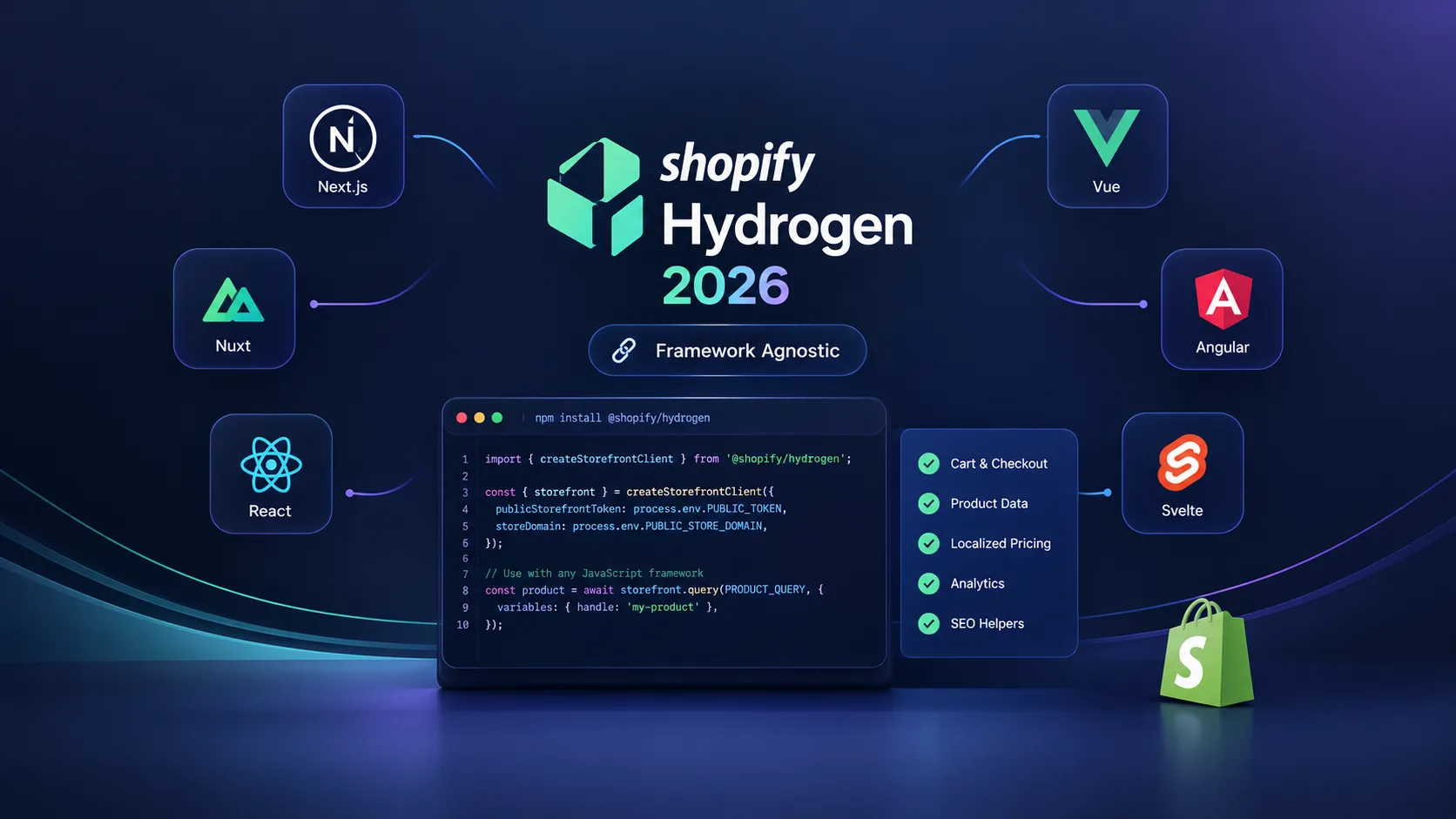
Shopify’s Hydrogen just dropped a release that quietly changes the calculus for every headless project: Hydrogen 2026 is framework-agnostic. You don’t have to replatform into the Hydrogen stack anymore—you add the library to whatever JS app you already have, and it handles the commerce layer for you. That’s a meaningful shift, and it deserves more than a changelog skim.
Here’s what this actually means for the stores and agencies I work with.
1. What actually changed in Hydrogen 2026
The old Hydrogen was an opinionated full-stack framework built on Remix. If you wanted Hydrogen, you were building a Remix app—full stop. That was fine if you were starting fresh, but it was a hard sell for teams with existing Next.js apps, Nuxt setups, or anything that wasn’t already in the Remix world.
The new Hydrogen drops that constraint. It’s a library now. You npm install it into whatever JavaScript app you’re running and wire up the commerce primitives you need. Cart, variant selection, prices in the buyer’s local currency, storefront data—Hydrogen owns that layer, your framework owns the rest.
Seven releases shipped during the developer preview since June. By the time GA landed today, the API had been shaped by real developer feedback. That’s worth noting because it means the rough edges of the preview are largely ironed out.
2. Framework-agnostic: what that looks like in practice
“Works with any JavaScript framework” is the kind of claim that can mean almost anything, so let’s be concrete. What Shopify is saying is that Hydrogen no longer dictates your rendering model, your routing, or your server runtime. You bring those. Hydrogen brings:
- Storefront API access with sensible defaults
- Cart state management
- Variant and product selection logic
- Localized pricing (buyer’s currency, not just store currency)
In practice, this means a Next.js App Router project can add Hydrogen’s cart utilities without abandoning its existing setup. A Nuxt team can pull in Storefront API helpers without rewriting their whole frontend. A plain Vite + React SPA—same deal.
The integration looks roughly like this:
      import { createStorefrontClient } from '@shopify/hydrogen';

      const { storefront } = createStorefrontClient({
        publicStorefrontToken: process.env.PUBLIC_STOREFRONT_TOKEN,
        storeDomain: process.env.PUBLIC_STORE_DOMAIN,
      });

      // Then use storefront.query() anywhere in your app
      // — no framework-specific adapter needed
      const { product } = await storefront.query(PRODUCT_QUERY, {
        variables: { handle: 'my-product' },
      });
That’s the shape of it—you configure the Storefront client once, and then the hooks and utilities are available throughout your app. The specifics will vary by framework but the pattern stays the same.
3. What Hydrogen handles for you
The cart is the piece I’d lean on hardest here. Building a correct Shopify cart from scratch against the Storefront API is annoying—you’re managing cart IDs in cookies, handling optimistic UI for add-to-cart, dealing with cart line merges on login, and keeping prices accurate when the buyer’s currency doesn’t match the store’s default. Hydrogen’s cart utilities have solved this problem across thousands of storefronts. That’s not a thing you want to reimplement.
Other things Hydrogen takes off your plate:
- Variant selection state — tracking which option combinations are available, sold out, or on backorder
- Localized prices — Shopify Markets integration without manual currency conversion logic
- SEO utilities — structured data and meta tag helpers that align with Shopify’s storefront schema
- Analytics hooks — page view and add-to-cart events wired to Shopify’s analytics pipeline
None of this is impossible to build yourself—but it’s all tedious and all error-prone. Delegating it to a maintained library is the right call.
4. The performance angle nobody’s talking about
Most of the Hydrogen coverage I’ve seen focuses on the developer experience angle—less lock-in, more flexibility. Fair. But there’s a performance story here that’s getting buried.
The old Hydrogen-on-Remix model was fast partly because Remix’s data loading patterns forced you into a server-first architecture. When you bring Hydrogen into an existing framework, you don’t get that for free anymore. You get the commerce primitives, but your framework’s default data-fetching behavior is still your data-fetching behavior.
What this means concretely: if you drop Hydrogen into a Next.js app that’s doing all its Storefront API calls client-side, you haven’t gained anything on LCP. You’ve just got a nicer cart API. The framework-agnostic model is only as fast as you make it.
Three things to get right on the performance side when integrating:
- Keep product and collection data fetches server-side—React Server Components or equivalent in your framework
- Treat cart state as the exception to the server-first rule: it’s inherently client state, and Hydrogen’s cart utilities are designed for that
- Watch your bundle size—Hydrogen is a library now, which means it needs to tree-shake well. Audit what actually ends up in your client bundle after integration
5. When I’d actually reach for this on a client project
I’ve worked on enough headless Shopify builds to know the pattern: the client wants headless for performance or design flexibility, but their team is already comfortable with a specific framework. Before Hydrogen 2026, that conversation usually went one of two ways—replatform the whole thing to Hydrogen/Remix, or build a DIY Storefront API integration from scratch.
Neither is great. The replatform is high-risk and high-cost. The DIY approach means you’re maintaining your own cart logic forever, which has a way of becoming a liability.
The framework-agnostic Hydrogen changes that calculus meaningfully. Here’s when I’d reach for it:
- Existing Next.js app adding Shopify commerce — this is the sweet spot. You keep your routing and data layer; Hydrogen handles cart and Storefront API ergonomics.
- Multi-brand setups — one frontend serving multiple Shopify stores. Hydrogen’s Storefront client accepts per-request credentials, which maps cleanly to multi-tenant patterns.
- Teams that want Shopify Markets from day one — the localized pricing stuff is genuinely hard to get right; Hydrogen earning its keep here.
When I’d not reach for it:
- Standard Shopify storefronts that don’t need a custom frontend — a well-optimized Liquid theme on Dawn or a solid paid theme will outperform a headless build on a tight timeline almost every time. Headless adds complexity. That complexity needs to pay for itself.
- Small catalogs with no internationalization needs — the overhead of maintaining a headless frontend isn’t worth it if you’re selling 20 SKUs in one country.
The honest take: Hydrogen 2026 makes headless Shopify more accessible, not automatically more appropriate. The question of whether to go headless at all is separate from whether Hydrogen is the right tool for the headless build—and I’d still want to answer the first question before touching the second.
If you’re weighing a headless Shopify build—or trying to figure out whether your existing theme is the actual performance bottleneck—check out what a Shopify speed optimization engagement looks like first. Sometimes the answer is headless; more often it’s targeted Liquid work and a leaner app stack. Either way, it’s worth knowing before committing to a replatform.
And if you’re already committed to a custom frontend and just need someone who knows where the Shopify-specific sharp edges are, book a call—happy to talk through the architecture.